
Scheduling a Price Increase
Once you have created your price increase schedule and given it a name, the next step is to set how prices should change.
Choose an increase type
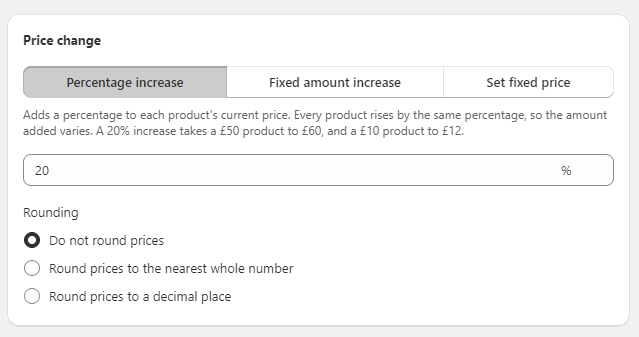
- Percentage increase — adds a percentage to each product's current price. Every product rises by the same percentage, so the amount added varies. A 20% increase takes a $50 product to $60, and a $10 product to $12.
- Fixed amount increase — adds the same amount to each product's current price. A $5 increase takes a $50 product to $55, and a $10 product to $15.
- Set fixed price — sets every product in the schedule to the same price, whatever it was before.
Rounding
For percentage increases, you can control how the resulting prices are rounded:
- Do not round prices — a 7% increase on $10.00 gives exactly $10.70.
- Round prices to the nearest whole number — $10.70 becomes $11.00.
- Round prices to a decimal place — round to the nearest value of your choice, e.g. 0.99.
- Round up prices to a decimal place — always rounds up to your chosen ending.
- Round down prices to a decimal place — always rounds down.
Important things to consider
- With an end date set, prices revert to the exact price each product had when the schedule started — even if you changed a price manually mid-schedule.
- Don't set more than one price change on the same product at the same time — including via collections that contain the same product. This can stack price changes on top of each other. The app shows a warning about this on the product selection step.